Table of Contents
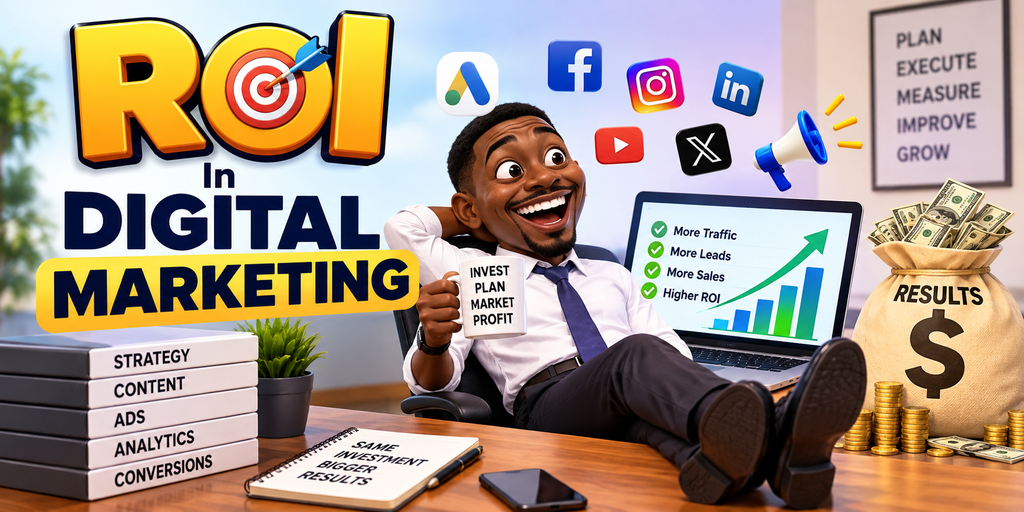
ROI IN DIGITAL MARKETING: 7 Powerful Secrets to Turn Marketing Spend Into Real Profit
Imagine giving someone ₦100,000 and saying:
“Please use this money to help my business make more money.”
A month later, they return and say:
“Good news! Your advert received 50,000 views!”
You smile.
Then you ask:
“Wonderful. How much money did we make?”
Silence.
😐
That is exactly why ROI in digital marketing matters.
Likes are nice. Followers are nice. Views are nice. Website traffic is nice.
But at the end of the day, businesses need to know something much more important:
“Did the money I spent on marketing actually produce a worthwhile return?”
That is the big question ROI helps answer.
According to Google, ROI is essentially a way of comparing the money generated by advertising with the costs involved. Google also recommends tracking valuable actions such as purchases, leads and sign-ups rather than looking only at clicks and impressions.
So, let’s make ROI ridiculously simple.
What Is ROI in Digital Marketing?
ROI means Return on Investment.
In ordinary English, ROI answers one simple question:
“If I put money into this, how much did I get back?”
Think about planting maize.
You spend ₦10,000 buying seeds, preparing the land and taking care of the farm.
Later, you harvest maize worth ₦30,000.
You didn’t just ask:
“How many maize plants did I grow?”
You want to know:
“Was the money I spent worth it?”
Digital marketing works in a similar way.
Instead of planting maize, you may invest money in:
- Google Ads
- Social media advertising
- Email marketing
- Content marketing
- SEO
- Website development
- Influencer campaigns
- Video advertising
The goal is not simply to spend money.
The goal is to create valuable business results.
A simple ROI formula
A common basic formula is:
ROI = (Revenue − Cost) ÷ Cost × 100
For example, suppose you spend ₦100,000 on a marketing campaign and that campaign produces ₦300,000 in attributable revenue.
Your simplified calculation would be:
(₦300,000 − ₦100,000) ÷ ₦100,000 × 100 = 200%
That means the return above the original marketing cost is ₦200,000.
However, remember that real ROI calculations can become more detailed because businesses may need to include other relevant costs, such as production, creative work, software or management expenses.
🧠 Granny’s explanation
If Grandma gives you ₦100 and you return with ₦300, Grandma won’t only ask:
“Did you enjoy yourself?”
She will ask:
“Where is my money?” 😂
That’s ROI.
ROI in Digital Marketing Is Not the Same as Likes
Let’s settle an important argument.
Your business posts a picture.
It receives:
❤️ 2,000 likes
💬 300 comments
👥 500 new followers
👀 50,000 views
Everybody celebrates.
But there are zero sales.
Was the campaign successful?
Maybe. Maybe not.
Likes and followers can tell you that people interacted with your content, but they do not automatically tell you whether the business made money.
Google makes a similar distinction: clicks and impressions are useful, but valuable customer actions such as purchases, sign-ups and leads are much closer to the business outcome you ultimately want to measure.
😂 MEME IDEA
Marketing Manager:
“We got 100,000 views!”
Business Owner:
“Excellent! How much did we make?”
Marketing Manager:
“…”
Business Owner:
“Exactly.”
The lesson
Do not completely ignore likes.
They can help you understand engagement and audience interest.
But don’t confuse engagement with profitability.
A post with 500 likes and 20 customers may be more valuable to a business than a post with 50,000 likes and zero customers.
7 Powerful Secrets to Improve ROI in Digital Marketing
Now let’s get to the interesting part.
How can a business move from:
“We’re spending money on marketing.”
to:
“We’re spending money intelligently.”
Here are seven powerful principles.
1. Know What You Are Trying to Achieve
Before spending ₦1 on marketing, ask:
“What exactly do I want this campaign to accomplish?”
Do you want:
- More sales?
- More enquiries?
- More leads?
- More website visitors?
- More bookings?
- More email subscribers?
- More people to download something?
- More repeat customers?
If you don’t know your destination, almost every road will look correct.
Simple example
Imagine a restaurant wants more customers.
Its goal might be:
“Generate 100 qualified enquiries this month.”
Now the business can measure whether its marketing is moving toward that goal.
🧠 MEME IDEA
Without a marketing goal:
GPS: “Where are you going?”
Business:
“Somewhere.”
GPS:
“Good luck.” 😂
2. Stop Measuring Only Vanity Metrics
Vanity metrics are numbers that look impressive but may not directly show business success.
Examples include:
- Likes
- Followers
- Impressions
- Views
- Shares
These numbers aren’t useless.
The problem comes when we treat them as proof of profit.
Consider two businesses.
Business A
50,000 followers
100,000 views
5,000 likes
₦50,000 in sales
Business B
5,000 followers
10,000 views
500 likes
₦500,000 in sales
Which business would you rather own?
Exactly.
Big numbers do not automatically mean big money.
The right metrics depend on the campaign’s objective.
If your goal is sales, measure sales.
If your goal is qualified leads, measure qualified leads.
If your goal is sign-ups, measure sign-ups.
3. Track Where Your Customers Come From
Imagine someone buys from your business.
You should be able to ask:
“How did you hear about us?”
Perhaps they say:
“I found you through Google.”
Another says:
“I saw your Instagram advert.”
Another says:
“My friend sent me your website.”
Another says:
“I received your email.”
Now you are beginning to understand your customer journey.
This information helps you identify which marketing activities are actually contributing to results.
Google recommends conversion tracking because it helps advertisers identify valuable actions and evaluate campaign performance.
Illustration idea
Create a simple funnel:
AD → WEBSITE → ENQUIRY → CUSTOMER → REVENUE
This is much more useful than simply:
AD → 10,000 VIEWS
4. Don’t Forget the Hidden Costs
Here’s where many ROI calculations become misleading.
Imagine you spend:
₦100,000 on advertising.
You make ₦300,000 in sales.
You might immediately shout:
“We made ₦200,000!”
But wait.
Did you also pay:
- ₦30,000 for design?
- ₦20,000 for video?
- ₦15,000 for marketing software?
- ₦25,000 for campaign management?
If those costs are relevant to the campaign, they should be considered when evaluating the true economics of the campaign.
The more complete your cost picture, the more useful your ROI calculation becomes.
A digital marketing campaign isn’t just the money paid to an advertising platform.
It can involve people, tools, creative work, technology and other expenses.
5. Test Before You Throw More Money at a Campaign
Here’s a simple rule:
Don’t keep feeding a campaign simply because you have already spent money on it.
Test.
Learn.
Improve.
Test another headline.
Test another audience.
Test another landing page.
Test another offer.
Test another creative.
Then compare the results.
Example
Suppose Campaign A produces:
₦2 for every ₦1 spent
Campaign B produces:
₦5 for every ₦1 spent
You now have evidence that Campaign B deserves closer attention.
ROI data can help businesses make better budget decisions and identify campaigns that deserve more or less investment.
😂 MEME IDEA
Campaign: “Please give me another ₦100,000.”
Business owner: “Why?”
Campaign: “Because I promise this time.”
Business owner: “Show me the data.”
😂
6. Give Your Customers a Reason to Buy
Sometimes the problem isn’t the advertisement.
The problem is the offer.
You can have a beautiful advert.
A fantastic website.
Amazing graphics.
But if customers don’t understand:
“Why should I buy this?”
they may simply walk away.
A strong digital marketing campaign should communicate:
- What you offer
- Who it is for
- What problem it solves
- Why it is valuable
- Why someone should trust you
- What the customer should do next
Your marketing should not merely say:
“LOOK AT US!”
It should say:
“HERE IS HOW WE CAN HELP YOU.”
That small change can make a huge difference.
7. Keep Improving Instead of Chasing Perfection
Digital marketing isn’t a magic button.
You don’t press:
“MAKE ME PROFITABLE”
and suddenly become a millionaire.
If only it were that easy! 😂
Digital marketing is a process.
You:
Plan → Launch → Measure → Learn → Improve → Repeat
A campaign that performs poorly today can provide information that helps you build a better campaign tomorrow.
The goal is not to make every campaign perfect.
The goal is to become smarter with every campaign.
How Do You Know If Your Digital Marketing Is Working?
Ask these questions:
1. Did we achieve the goal?
If the goal was 100 leads and you got 5, something needs attention.
2. How much did we spend?
Know your actual marketing costs.
3. How much revenue can reasonably be attributed to the campaign?
Don’t simply assume every sale came from the campaign.
4. What did each customer cost us?
This can help you understand whether acquiring customers is economically sustainable.
5. Which channel performed best?
Was it:
Google?
Social media?
Email?
SEO?
Referral?
Your website?
6. What should we do differently next time?
This is where the real value of measurement appears.
ROI vs ROAS: Are They the Same Thing?
No.
They are related, but they are not identical.
ROAS means Return on Ad Spend.
It focuses specifically on revenue generated compared with advertising spend.
ROI is broader and can account for the wider costs associated with generating the return.
For example, an advertising campaign might show an attractive ROAS while the overall campaign produces a weaker ROI after other relevant expenses are considered.
Think of it this way:
ROAS asks:
“How much revenue did my advertising generate compared with my ad spend?”
ROI asks:
“After considering the relevant investment and return, was this actually worthwhile?”
Both can be useful.
The Biggest Mistake: Thinking Marketing Is Only About Immediate Sales
Here’s something important.
Not every marketing activity produces an immediate sale.
A person may see your brand today.
Visit your website next week.
Follow you next month.
Read three of your articles.
Join your email list.
Then finally become a customer three months later.
That means measuring marketing can sometimes be more complicated than simply looking at today’s sales.
This is especially important for businesses with longer buying journeys.
So don’t automatically label a campaign a failure simply because someone didn’t buy immediately.
Instead, understand the customer journey and decide which outcomes matter for your business.
A Simple ROI Example for a Nigerian Business
Let’s imagine a small Nigerian business spends:
₦200,000 on a digital marketing campaign.
The campaign generates customers who produce:
₦600,000 in attributable revenue.
Using the simple formula:
ROI = (Revenue − Cost) ÷ Cost × 100
ROI = (₦600,000 − ₦200,000) ÷ ₦200,000 × 100
ROI = 200%
That sounds impressive.
But remember:
This is a simplified example.
A real business should consider the appropriate costs and attribution method before declaring exactly how profitable the campaign was.
That’s why good measurement is not about manipulating numbers to look beautiful.
It’s about telling the truth.
The Golden Rule of ROI in Digital Marketing
Here is the principle I want you to remember:
Don’t ask only, “How many people saw my marketing?” Ask, “What did my marketing accomplish?”
There is a massive difference.
10,000 views is a marketing activity.
500 qualified enquiries is a business outcome.
100 customers is a stronger business outcome.
₦5 million in profitable revenue attributable to your marketing tells a much bigger story.
The numbers you track should connect your marketing activity to the actual goals of your business.
Final Thoughts: Don’t Just Spend. Invest.
Digital marketing should not feel like throwing money into a dark room and hoping somebody catches it.
Your money deserves a job.
Every naira you spend should ideally teach you something, generate something, or move your business closer to its goal.
ROI helps you answer the question:
“Was this investment worth it?”
And that question is important whether you’re a huge corporation, a small business owner, a freelancer, a startup founder or someone selling their first product online.
Remember:
Views are not revenue.
Likes are not profit.
Followers are not customers.
Traffic is not automatically sales.
They can all be useful signals—but the ultimate goal is to understand whether your marketing is creating meaningful business value.
So the next time someone proudly tells you:
“Our campaign got 100,000 views!”
Don’t ruin their celebration. 😂
Just smile and ask:
“Fantastic. Now, what did it do for the business?”
That is where ROI in digital marketing begins.
Quick ROI Checklist
Before launching your next campaign, ask:
☑ What is my objective?
☑ How much am I investing?
☑ What result am I expecting?
☑ How will I track conversions?
☑ Where are my customers coming from?
☑ What are my total relevant costs?
☑ Which channel is performing best?
☑ What can I improve?
☑ Can I connect the campaign to real business outcomes?
If you can answer these questions, you’re no longer simply doing digital marketing.
You’re measuring digital marketing intelligently.
And that is how marketing spend can become a genuine investment in business growth.